Overview
Why transparent, accountable systems?
- General perspective of TAMI project:
- view of the relationship between law and society
- deep openness of Web-based social interactions
- Privacy Challenges: Technical and legal
- Accountability Design Requirements for Privacy Protection
- Application of accountability to other public policy problems
Law and Society -- a pop quiz
- How many believe you are subject to law (any law)?
- How many of you follow (most) laws? [exclude speed limits]
- How many of you read all the laws to which you believe you are
subject?
- How many have been to a court of law?
General goal: Making the Web 'Policy Aware'
How will the Web finally catch up with the 'real world'?: in everyday
life, the vast major of 'policy' problems get worked out without recourse to
legal system.
Design goal: instrument the Web to provide seamless social interactions
which allow us to avoid legal system the way we do in the rest of life
Global perspective: In the shift from centralized to decentralized
information systems we see a general trend:
ex ante policy enforcement barriers -> policy description
with late binding of rules for accountability
B. Privacy Challenges -- then and now
B. Privacy challenges in decentralized systems
Less worry about collection
More worry about
- aggregation
- integration
- wide-ranging inferencing
Property (intellectual)
Departure from Hollywood content (centralied production)
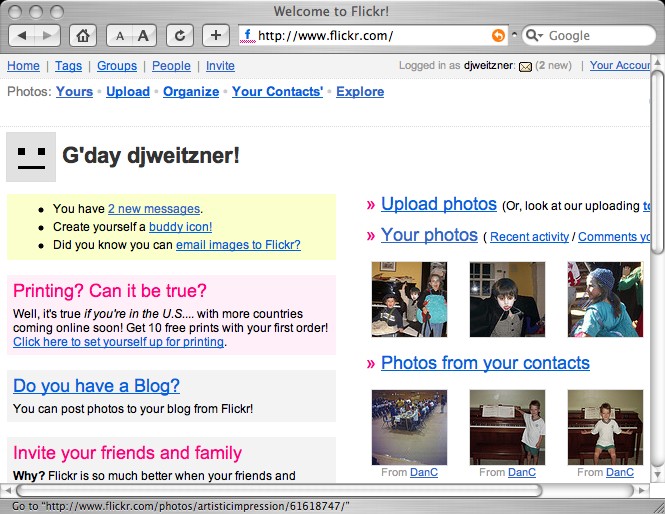
-> Blogs, Flickr and Livejournal (decentralized content we all make)
Property (intellectual)
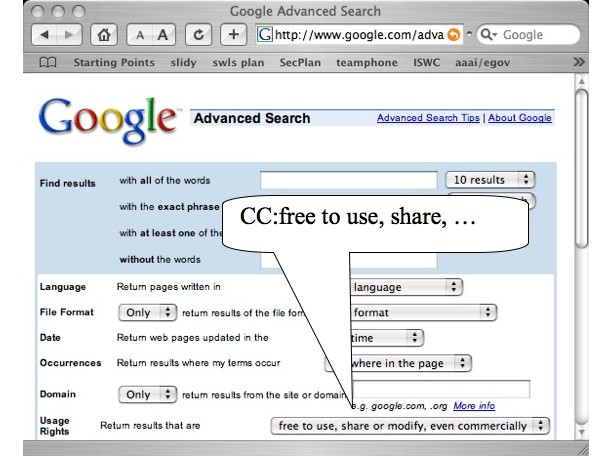
Move from up-front enforcement barriers (DRM) -> open
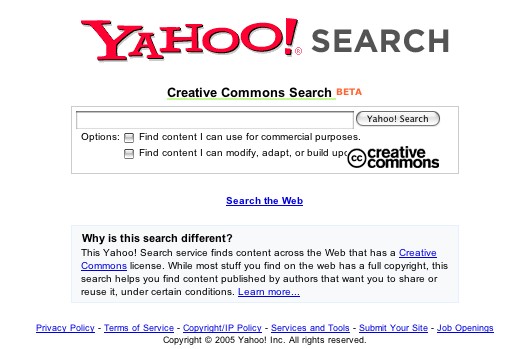
description of licensing terms (CC) with after-the-fact enforcement
as needed
C. Privacy: the dilemma of consent
Can consent model (EU opt-in or US opt-out) be effective going forward?
Key will be purpose limitation, but we have a dilemma...
- narrow purpose definition -> lots of choices = large time investment
will yield privacy protection and low flexibility
- broad purpose limitation -> few choices = small time investment
required but less privacy protection
Dilemma: limited individual and regulatory capacity to control escalating
data uses.
Result of consent dilemma + increased inference power: strict about what's
collected but loose about usage
Collection Limitation -> Use Limitation
We're at the wrong end of the privacy spectrum and seeking the wrong
results:
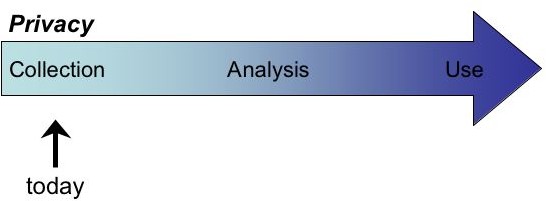
Collection Limitation -> Use Limitation
Still suboptimal control point:
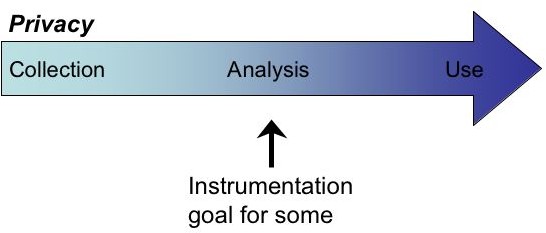
Collection Limitation -> Use Limitation
This is where we should be:
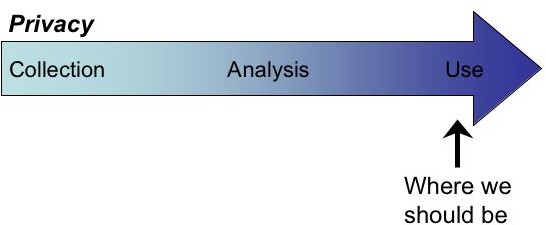
Collection Limitation -> Use Limitation
Why?
- Rules express core values!!
- Better allocation of individual and regulatory effort
- Often the only logical evaluation point
Other uses of accountable systems
- Health Privacy
- Credit Reporting
- Copyright management (DRM alternative)
Toward Transparent, Accountable Systems
How?
Laws and other social rules:
- specify permissible and impermissible uses
- require proof of permissible use along with adverse action (in
high-sensitivity situations (government access, health records, ...)
- learn how to match expressivity of legal rules with inferencing
power
Systems:
- formal specification of rules over data (working on a purpose
algebra)
- tools to explore accountability to rules upon 'adverse action' (Hal
Abelson)
- generate and check proof of compliance (Deb McGuinness)