Standards, Patents and the Dynamics of Innovation on the Web

Daniel J. Weitzner
MIT Computer Science and Artificial Intelligence Laboratory

Technology & Society Domain Lead
Co-Chair, W3C Patents and Standards Interest Group

Overview

Historical Motivation

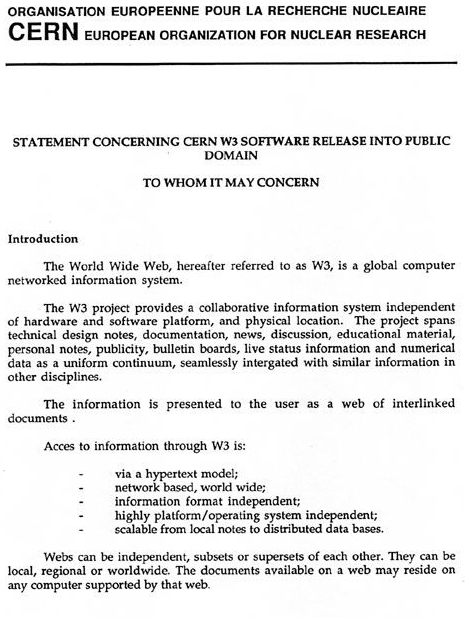
CERN license
  • 1993: CERN contributions Web infrastructure to the public domain
  • 1994-1998: Community norms avoids patent licensing issues
  • 1998-1999: Patent holdup of 5 W3C specifications
  • October 1999: Patent policy development begins

What We Have Learned

The Web and Standards

Sources of Innovation: The XML Eleven

Arbortext - Eve Maler NCSA - Tom Magliery
Dynasoft - Steve DeRose Softguard - Peter Sharp
Hewlett-Packard - Dave Hollander Sun - Jon Bosak
Independent - Elliot Kimber Textuality - Tim Bray
Independent - James Clark Univ. Illinois - Michael Sperberg-McQueen
Microsoft - Jean Paoli

Sources of Innovation: Critical Web Infrastructure

Key infrastructure components widely available:

Server

Apache

Scripting

Perl

Browser

Mozilla

Low barriers to entry as important as technical bells & whistles

Diversity of Business Models

Requirement to find common ground across:

"Uneasiness" over software patents

W3C Response: Patent Policy Favoring Royalty-Free Standards

Goal: Produce Recommendations implementable on Royalty-Free basis and allow technical work to with minimal interruption

Method:

W3C Royalty-Free Licensing Commitment

(Social) Contract Among Specification Designers and Developers:

W3C Royalty-Free Licensing Requirements

Requirements for a license: (partial list)

  1. available to all
  2. all Essential Claims 'owned or controlled'
  3. field of use limitation allowed
  4. reciprocity
  5. no fees
  6. defensive suspension
  7. no other conditions

Disclosure

Policy Requirements

W3C Community Decisionmaking Process

Extensive debate
  • Open Source community contribution (NZ)
  • Final poll: highest level of W3C Member support for ANY W3C action.

W3C's Director's Decision

"Based on overwhelming support of the W3C Membership, consensus in the Patent Policy Working Group and support from interested members of the public, I have determined that the proposed Royalty-Free Patent Policy should become the Patent Policy for W3C. The Policy affirms and strengthens the basic business model that has driven innovation on the Web from its inception.

The availability of an interoperable, unencumbered Web infrastructure provides an expanding foundation for innovative applications, profitable commerce, and the free flow of information and ideas on a commercial and non-commercial basis."

-Tim Berners-Lee, May 2003

Patent Policy Implementation Experience

W3C Standard Setting Activity (As of November 2006) (live status)

Conclusion


Creative Commons License
This work is licensed under a Creative Commons Attribution-NonCommercial-NoDerivs 2.5 License.